

GPS Guidance vs Autosteer: Which Do You Need?
"GPS guidance" and "autosteer" are often used to mean the same thing, but they're two different levels of technology, and the gap between them is cost, accuracy and how much you still steer yourself. Here's a clear comparison so you can decide which your farm actually needs.
What GPS guidance is
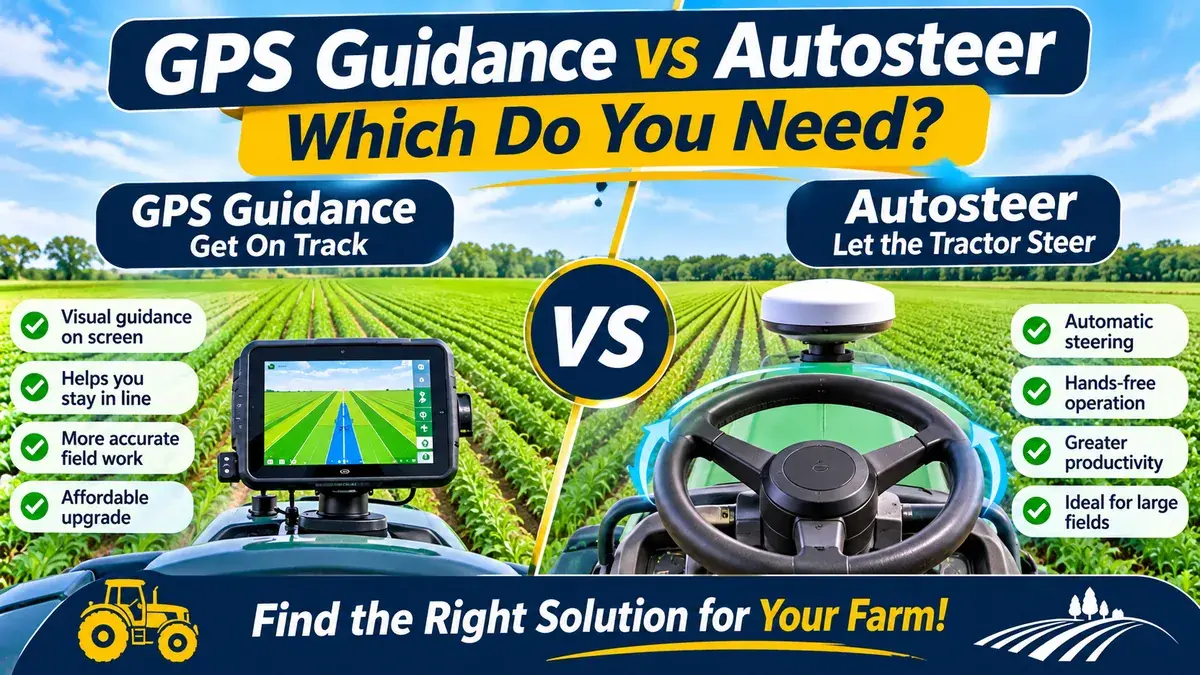
A basic GPS guidance system for tractors shows you where to drive, but you still steer. A lightbar or on-screen display tells you how far you are off the line, and you keep the tractor on course by hand. It's affordable, simple to fit, and cuts overlap and skips compared with steering by eye, especially for spraying and spreading.
What autosteer is
Autosteer takes over the steering for you. The same GPS guidance line is followed automatically by a steering unit, so the tractor drives the passes while you supervise. It's more accurate, far less tiring on long days, and repeatable to the centimetre with RTK, which matters for planting, strip-till and controlled-traffic work.
The key differences
- Who steers — guidance: you do, following a line. Autosteer: the tractor does.
- Accuracy — guidance depends on your hands and tiredness. Autosteer holds the line to about 2.5 cm with RTK, every pass.
- Fatigue — guidance still means steering all day. Autosteer removes that.
- Cost — guidance is the cheaper entry point; autosteer costs more but does more.
When GPS guidance is enough
If your main jobs are spraying, spreading or general cultivation, and you mostly want to cut overlap and input waste, a manual guidance system for tractors can be all you need, at a lower price. The FJD AG1 guidance system is a good entry point for this.
When to step up to autosteer
If you do repeatable row work, run long days, or want hands-free passes and automatic U-turns, autosteer pays back fast in saved inputs, time and fatigue. Browse complete kits in Autosteer Systems — electric wheel, steer-ready and hydraulic, all with RTK accuracy.
Which should you choose?
Start with the work you do most. Light, occasional straight-line jobs lean towards guidance; repeatable, all-day, high-accuracy work justifies autosteer. Many farmers begin with guidance and upgrade to autosteer as their acreage and precision needs grow. For help matching a system to your tractor, see our how to choose an autosteer system guide.
